Archive of news

Direct imaging captures the crystalline vibrations of a supersolid made of atoms and light

For the first time ICFO researchers and Dynamite project members, in collaboration with scientists from UAB, have directly imaged a spin-orbit-coupled supersolid. The team has observed quantum fluids of atoms forming stripes whose spacing oscillates in time, as the spacing of a crystal does. These results, published in Science, demonstrate unequivocally the dual superfluid and crystalline nature of such systems.

Read more

When atoms lose their sense of colour

A research team led by Monika Aidelsburger at the Max Planck Institute of Quantum Optics (MPQ) and the Ludwig-Maximilian University Munich (LMU) has identified a colour of light at which atoms become selectively “colourblind”: At this wavelength, the light has no effect on excited-state atoms, but strongly confines atoms in the ground state. The results, published in PRX Quantum, provide a powerful new tool for analogue quantum simulation and novel computing architectures.

Read more

First real-time measurement of quantum uncertainty with ultrafast squeezed light

The uncertainty principle, proposed by Werner Heisenberg nearly a century ago, has remained a central pillar of quantum mechanics, dictating that certain properties of light and matter cannot be simultaneously measured with arbitrary precision. Until now, however, the uncertainty principle had never been directly observed and tracked in real time.

Read more

How a Superfluid Simultaneously Becomes a Solid

In everyday life, all matter exists as either a gas, liquid, or solid. In quantum mechanics, however, it is possible for two distinct states to exist simultaneously. An ultracold quantum system, for instance, can exhibit the properties of both a fluid and a solid at the same time. The Synthetic Quantum Systems research group at Heidelberg University, including Dynamite team members, has now demonstrated this phenomenon using a new experimental approach, by feeding a small amount of energy into a superfluid. They showed that, in a driven quantum system of this kind, sound waves propagate at two different speeds, which points towards coexisting liquid and solid states, a hallmark of supersolidity.

Read more

Global contest puts analysis tools for single-molecule motion analysis to the test

In the intricate world inside living cells, molecular motion reveals crucial clues about how cells function, communicate, and sometimes fail. But extracting meaningful insights from these complex molecular trajectories is a formidable challenge, one that has spurred a global race to develop better analytical tools.

Read more

New insights into light-matter interactions provide a deeper understanding of quantum materials

A collaboration led by ICTP, including Dynamite project members, has developed the first theoretical model of the fractional quantum Hall effect in a cavity. Published in Physical Review X, the study opens new avenues for understanding quantum matter by predicting new light-matter correlated states and lays a solid foundation for future theoretical and experimental investigations.

Read more

Quantum simulation with interacting ultracold atoms: recent progress and future perspectives

A team of researchers, including Dynamite partners, provides an updated review of non-standard Bose-Hubbard models, a theoretical framework typically used to describe quantum simulators using ultracold atoms with various kinds of interactions. The review compiles recent results in the field and discusses how intriguing states of matter and quantum mechanical effects can emerge in these systems.

Read more

Scientists create vacuum-ultraviolet attosecond pulses to track ultrafast processes of natural systems

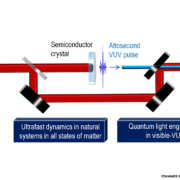
A team of researchers, including Dynamite project team members, has presented a new technique in Nature Communications capable of generating and characterizing vacuum-ultraviolet attosecond (10-18 seconds) light pulses using semiconductor crystals illuminated by strong laser fields. With these pulses, the study of ultrafast dynamics in natural systems in all states of matter becomes possible.

Read more

Showing how quantum simulators can explore otherwise inaccessible phenomena

A Colloquium in Reviews of Modern Physics provides an introduction to the field of quantum simulation of exotic geometries without a real-world counterpart. The review, authored by some Dynamite team members, highlights unique opportunities offered by different platforms and discusses the novel physical phenomena that can be addressed with them.

Read more

Building New Bridges in Science

To understand is to create new connections, to find links between something we do not know and what we know well. Understanding many-body quantum systems – collections of many quantum particles — holds the promise to bring us a step closer to building quantum computers, extremely fast and efficient machines that will help us solve problems that classical ones cannot handle. The peculiar nature of quantum interactions, however, makes this an arduous enterprise.

Read more